Brand Marketing vs Performance Marketing: The Best Campaigns Do Both
By Aaron Edwards, CEO, and Samantha Edwards, CCO. The Charles Group.
For the last decade, every marketing conversation has come back to the same false choice. Brand or performance. Awareness or conversion. Long-term equity or this quarter’s revenue. Pick a lane.
It’s tidy. It’s also wrong.
The brands we work with at The Charles Group can’t pick one. They need to be remembered by the right people and bought by them this quarter. They need to mean something in a category and move units off a shelf. They need a Cartier-grade brand story and an HP-grade pipeline.
Here is what the data actually shows. The brands seeing the strongest results aren’t picking a lane. They run brand and performance against the same strategy, and the two sides make each other better. Brand work makes performance work cheaper. Performance work makes brand work accountable. Run them together and they multiply. Run them in silos and they cancel each other out.
This article is about how to stop choosing.
What follows is why the old debate is over, what the integration actually looks like in practice, a case study from our BIRKENSTOCK work that shows the model end to end, a five-step framework you can apply, and a vertical-by-vertical view of what changes when you do.
The False Choice
The brand vs. performance split didn’t appear out of nowhere. It was a real organizational reality for years.
Brand teams owned awareness, recall, and equity. They measured success in unaided recognition, NPS, and earned media. Performance teams owned acquisition, conversion, and ROAS. They measured success in CPA, AOV, and last-click revenue. The two groups sat in different rooms, reported to different leaders, and protected different budgets. When the CFO came asking what worked, the brand team pointed to long-term trendlines and the performance team pointed to a dashboard. The performance team usually won.
So the model hardened. Brand became a cost center. Performance became the growth engine. A generation of marketers grew up believing the two disciplines weren’t just operationally separate. They were strategically opposed.
That belief is broken now, for three reasons.
First, attribution got harder, not easier. Cookie deprecation, privacy regulation, and walled gardens have made last-click measurement less reliable than it was in 2015. The performance teams that thought they had certainty are working with the same fuzz everyone else is.

Second, the channels themselves merged. The same Meta ad can be optimized for video views (a brand metric) or conversions (a performance metric). A connected TV buy can be measured against incremental sales lift. A YouTube creator partnership can drive consideration and DTC revenue in the same week. The infrastructure no longer enforces the silo.
Third, the brands worth copying have already moved on. Nike doesn’t run brand and performance as separate disciplines. Neither does Apple. Neither does the new generation of category-defining DTC brands. They run integrated campaigns where the brand idea and the conversion vehicle are designed together from the start.
Brand vs. performance is the wrong question. The right question is how do we make every dollar do both jobs.
What Actually Works
Our shorthand at The Charles Group is straightforward. Every campaign needs a brand truth and a performance hypothesis. The brand truth is what we want a person to feel and remember. The performance hypothesis is what we expect them to do and how we’ll know if they did it. We don’t pick. We design for both, and we measure both.
That changes a lot of things in practice.
It changes the brief. A creative brief that only asks “what’s the message?” produces brand work. A brief that only asks “what’s the CTA?” produces performance work. Our briefs ask both, and they ask them in the same room with the same team.
It changes the team. Strategist, creative director, and media lead build the plan together from day one. Performance isn’t a downstream channel that picks up assets after the brand campaign launches. Performance shapes the brand campaign because what performs is itself a signal about what resonates.
It changes the measurement. Brand KPIs (awareness, consideration, brand search lift, sentiment) and performance KPIs (CTR, conversion rate, CPA, ROAS, incremental revenue) get set at the same time, against the same audience, on the same dashboard. When something moves, we can see whether it moved for brand reasons, performance reasons, or both. That tells us where to push next.
“The CFO doesn’t care whether a dollar got tagged as brand spend or performance spend. They care whether the dollar moved the business. Our job is to design campaigns where every dollar does both jobs, and to prove it.”
Aaron Edwards, CEO, The Charles Group
The creative side of the integration matters as much as the strategic side. A high-performing piece of creative isn’t the enemy of brand. Some of the most enduring brand assets in our portfolio also happened to be the best-performing creatives we ever ran. The myth that performance creative is ugly and brand creative is beautiful is just a myth. Performance creative becomes ugly when it’s made without taste. Brand creative becomes ineffective when it’s made without rigor. The good version of both looks the same. A tight idea, executed with craft, designed to do a specific job.
“Performance isn’t the opposite of beautiful. The most performant work we make is also the most considered. When the idea is right and the craft is high, the numbers follow.”
Samantha Edwards, CCO, The Charles Group
Case Study Deep-Dive: BIRKENSTOCK
To make this concrete, look at the work we did for BIRKENSTOCK.
The brief was unusual. BIRKENSTOCK wanted to be understood as recovery footwear for runners. Not casual footwear. Not lifestyle footwear. Recovery. The kind of shoe a serious runner puts on after a long training day to let the body reset. That positioning is a brand claim. It’s also a commercial claim. If it lands, it opens an entirely new use case and an entirely new customer.
The brand-only version of this would have been beautiful and untargeted. The performance-only version would have been efficient and forgettable. We built something else.
The strategy started with audience, not aesthetics. Runners are not a single demographic. The casual jogger, the marathoner, and the ultramarathoner consume different media, talk in different vernaculars, and trust different sources. We mapped the psychographic and media habits of each subsegment, and that map drove both the creative framework and the paid media plan. Insider language was non-negotiable. A campaign that talked to runners had to sound like it was made by one.
The creative anchored on two real ultramarathoners, Arden Young and Scott Jurek, and a single visual idea. The symmetry between the contours of the human body and the contours of the BIRKENSTOCK footbed. The campaign line was the proof point. The human body is designed for running. BIRKENSTOCK is engineered for recovery. That sentence carried the brand promise. It also carried the conversion logic.
Then the integration kicked in. The same idea ran as long-form video on the brand’s owned channels (brand build), as targeted paid social and programmatic against runner audiences (performance pull), and as on-site content on the BIRKENSTOCK e-commerce experience (conversion close). Performance creative was cut from the same shoots as the brand films. Audience signals from the performance side fed back into the brand side and informed what we made next.
“Runners aren’t a one-size-fits-all demographic. We looked at the media habits and audience psychographics of casual joggers, ultramarathoners, and everyone in between to inform both the comms framework, the paid media strategy, and the measurement plan.”
Aaron Edwards, CEO, The Charles Group
The numbers tell the integration story. The campaign generated over 60 million impressions in the first 60 days. The highest-reaching digital-first launch in Birkenstock’s history. The brand films pulled an 86% video completion rate on YouTube against a category benchmark of roughly 30%, which is the kind of result you only get when audience targeting and creative are designed together. On the performance side, our CPMs on Meta came in 75% below benchmark for the fashion category.

The point isn’t any single number. The point is what the numbers say together. A niche-audience brand campaign, designed and bought with discipline, beat the broad-reach playbook on brand metrics and efficiency at the same time. Efficiency starts with scale. Niche-audience brand campaigns are the new standard for brand awareness.
The campaign wasn’t measured as brand spend or performance spend. It was measured as one campaign with a brand effect and a performance effect, and held accountable for both.
Read the full BIRKENSTOCK case study → thecharlesgrp.com/work/birkenstock
The Framework
If we had to compress the model into a five-step process any brand could apply, it would look like this.
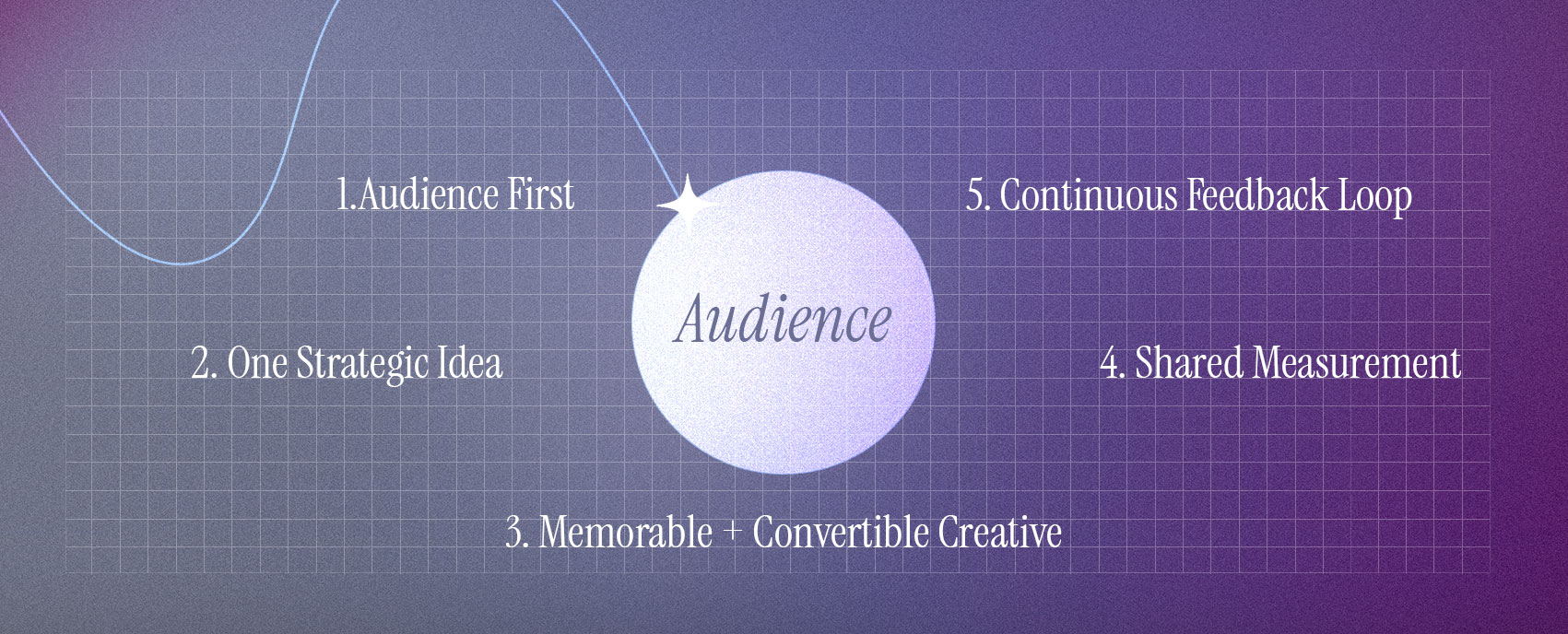
1. Start with the audience, not the channel.
Most campaign planning starts with budget allocation by channel. This much to brand, this much to performance, this much to social, this much to search. That’s an artifact of how teams are structured. It’s not how customers behave. Real customers don’t move through brand and performance funnels in sequence. They move through a category, encountering you in a thousand fragmented moments. Start by mapping who they are, what they care about, and where their attention lives. The channel mix falls out of the audience map.
2. Define one strategic idea that has to do both jobs.
The single most useful discipline in integrated work is forcing the strategy team and the creative team to land on one idea that is both a brand position and a conversion proof point. “BIRKENSTOCK is engineered for recovery” is a brand line. It’s also the reason a runner clicks a paid ad. If your idea can survive only as a brand line or only as a performance hook, it’s not the right idea.
3. Build creative that is good enough to remember and specific enough to convert.
The common failure mode of integrated campaigns is hedging. Creative that’s neither distinctive enough to register nor specific enough to drive an action. The fix is to brief for both jobs at once and staff the brief with people who care about both. The best performance creative we’ve made was made by people who cared about craft. The best brand creative we’ve made was made by people who cared about the dashboard.
4. Measure two scoreboards against the same audience.
Set brand KPIs (awareness lift, consideration lift, brand search volume, sentiment) and performance KPIs (CTR, conversion rate, CPA, ROAS, incremental revenue) at kickoff. Track both throughout the flight. Read both scoreboards together. A performance spike with no brand lift is a sugar high. A brand spike with no performance signal is invisible to the CFO. The campaigns worth funding move both.
5. Let each side feed the other.
The biggest unlock in an integrated model is that the two sides become inputs to each other. Performance data tells the brand team which messages are landing and with whom. Brand research tells the performance team which audiences are warming up and worth targeting more aggressively. Run that loop for two or three flights and the campaigns get measurably better. The spend doesn’t grow. The system learns.
This is the model. The hard part isn’t the framework. The hard part is the organizational discipline to actually run it.
What This Means for Your Vertical
The framework holds across categories. What changes is the emphasis. Here is how we think about the integration across the four verticals where we do the most work.
Luxury
The mistake luxury brands make most often is treating performance as beneath them. The view tends to be that retargeting ads cheapen the brand, that conversion-focused creative is for mass-market players, and that the right job of marketing is to maintain mystique. The view is wrong, and the numbers don’t support it.

Our luxury work across Cartier, Aveda, Omega, IWC, and a roster of luxury residential and hospitality clients shows the same pattern. The houses willing to pair an aspirational brand idea with a disciplined performance layer outperform the ones that stay pure. Performance doesn’t have to look like a retargeting banner to be performance. A precisely targeted brand film, served to a one-percent audience with the right context and the right frequency, is performance. A site experience that turns a brand story into a considered purchase is performance. The luxury houses winning right now are the ones that treat every brand asset as a commercial instrument and every commercial instrument as a brand asset.
Hospitality
Hospitality and luxury residential live or die by emotion. The decision to book a stay, sign a lease, or buy a unit is one of the most emotionally loaded purchases a consumer makes. That argues for brand. The deal also has to close, which argues for performance.

Our work with The Seagate Delray is the clearest expression of this in our portfolio. The brief was a digital reintroduction of a landmark property after a major physical transformation, and the marketing program started with two integrated workstreams running in parallel. On the brand side, we built a lo-fi, experience-driven organic social presence across Instagram, Facebook, and TikTok. Native-first storytelling that articulated what staying at the property actually feels like. On the performance side, we scaled what had been a single-channel Google Ads account into a full omnichannel paid program across Google and Meta, including building Meta’s conversion pixel from scratch.
The integrated results tell the story. On the paid side, year-over-year revenue grew 124%, clicks grew 570% (from 13K to 87.7K), and impressions grew 3,621% (from 155K to 5.8M). Average cost per click dropped 94% (from $1.96 to $0.11). The hotel booking campaign ran at a 7.69x ROAS in October. We returned an 815% ROI on incremental spend versus the prior year. On the organic side, the same period drove a 98% increase in impressions, a 483% increase in monthly Instagram followers, a 3,225% increase in Facebook follower growth, and an 88% increase in content output, all at a 2.06% engagement rate across platforms.
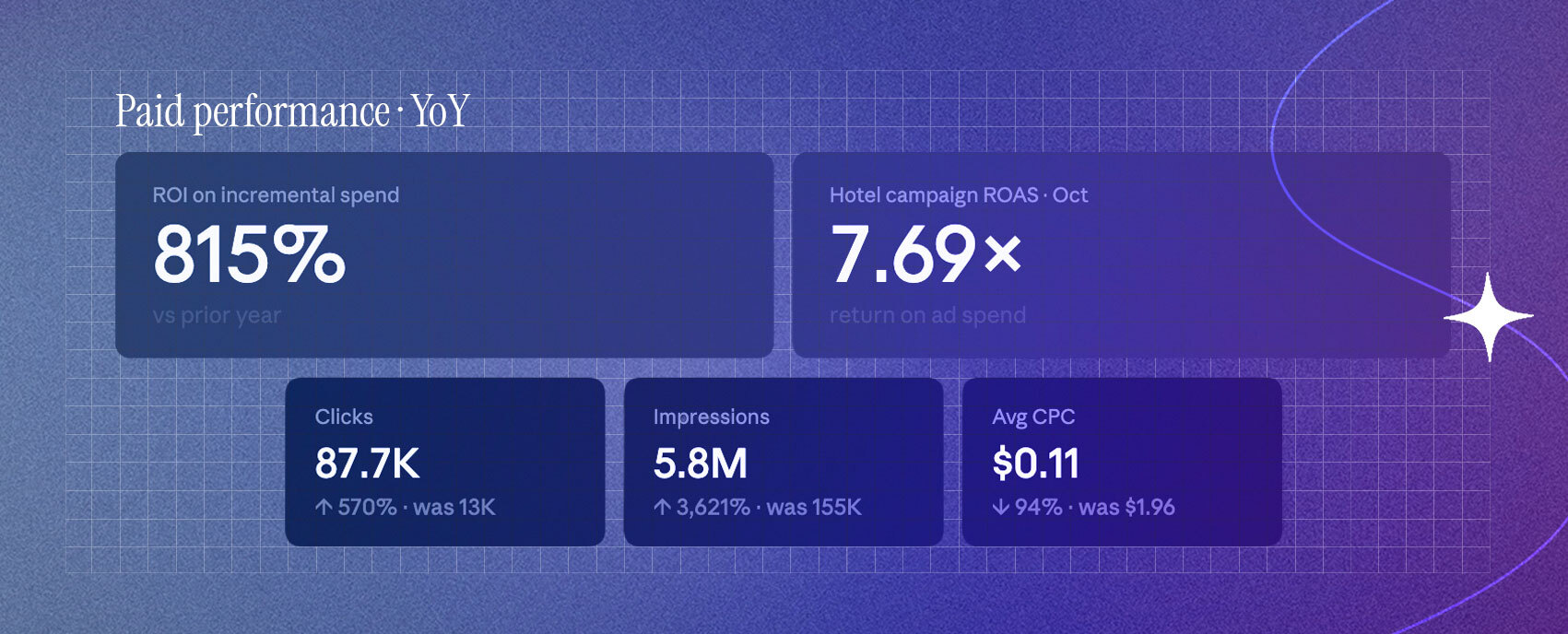

Two scoreboards, one strategy. The brand layer earned attention. The performance layer converted it. Neither would have produced those numbers on its own.
Read the full Seagate Delray case study → thecharlesgrp.com/work/the-seagate-delray
Financial Services
Financial services has the opposite problem. Most financial brands lean too heavily on performance. Endless paid search against high-intent keywords. They underinvest in the brand layer that earns long-term consideration. The result is a category where every brand sounds the same, every CPA climbs over time, and trust never compounds.
The integrated answer in financial services is to build a brand idea that earns category authority. Original research, distinctive POV, thought leadership delivered with craft. Then deploy a performance layer that captures the demand that authority creates. Brand search lift is the metric that matters here. When your brand search volume is growing faster than your category’s, your performance spend is working harder. The audience is showing up already warm.
Technology and B2B
In B2B technology, the buying committee makes the integration mandatory. There is no enterprise software purchase that happens on a last-click. There is also no enterprise software purchase that happens without a pipeline.
Our ongoing work with HP across hardware, software, and services is built around a single mandate. Connect brand storytelling to revenue. The brand layer builds category authority and earns the right to be in the consideration set. The account-based performance layer reaches the buying committee, supports the sales motion, and produces measurable pipeline. Brand makes the meeting happen. Performance makes the deal close. Neither one is optional.
The Bottom Line
The marketers we trust most stopped having this argument years ago. They know that brand work without performance is a luxury most businesses can’t afford. They know that performance work without brand is an arms race most businesses can’t win. They run both against one strategy and ask every dollar to do both jobs.
At The Charles Group, this isn’t a side specialty. It’s the operating model. We call it “Brandformance”. We’ve run it for global luxury houses, hospitality and real estate developers, Fortune 500 technology brands, and category-defining DTC players. If you’re sitting across a brand-vs-performance debate inside your own organization and looking for a way out, we’d be happy to walk through how we’d think about it for your business.
Learn more about our Strategy & Consulting practice, or get in touch about a brand and performance integration audit for your team.