The Complete Guide to Luxury Brand Marketing: Strategy, Channels and Measurement
By Samantha Edwards, Co-Founder and Chief Creative Officer, The Charles Group
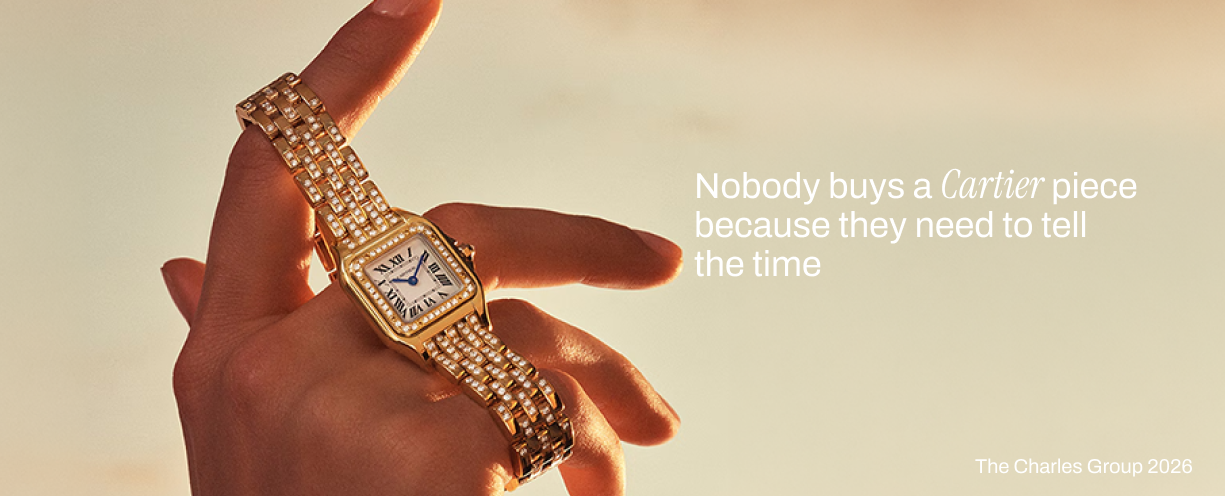
Luxury brand marketing follows a different set of rules than the rest of the discipline, and the first of them is that the product is rarely the point. Nobody buys a Cartier piece because they need to tell the time, and nobody chooses Omega over a cheaper alternative on the strength of a feature list. They are buying into a world, and into the version of themselves that world implies, so when the brand gets that wrong, no media budget is large enough to save the work.
We’ve spent close to 15 years building campaigns for prestige brands in jewelry, watchmaking, fashion, hospitality, lifestyle, skincare and personal care, and the same patterns hold across all of them. Aspiration sells harder than information, and restraint reads richer than volume, which is why the brands that win tend to be the ones with the discipline to say less and mean more.
This is the working model we use at The Charles Group, and it covers what separates luxury from mass market, where the spend should actually go, how prestige content gets made in 2026, and how to read brand health when a single click tells you almost nothing worth knowing.
What Makes Luxury Marketing Different
Mass-market marketing solves a problem. It finds people with a need and answers it clearly, taking the friction out of the path to purchase, because speed and clarity are what win. The faster you can connect a need to a solution and then to a checkout, the better the campaign performs.
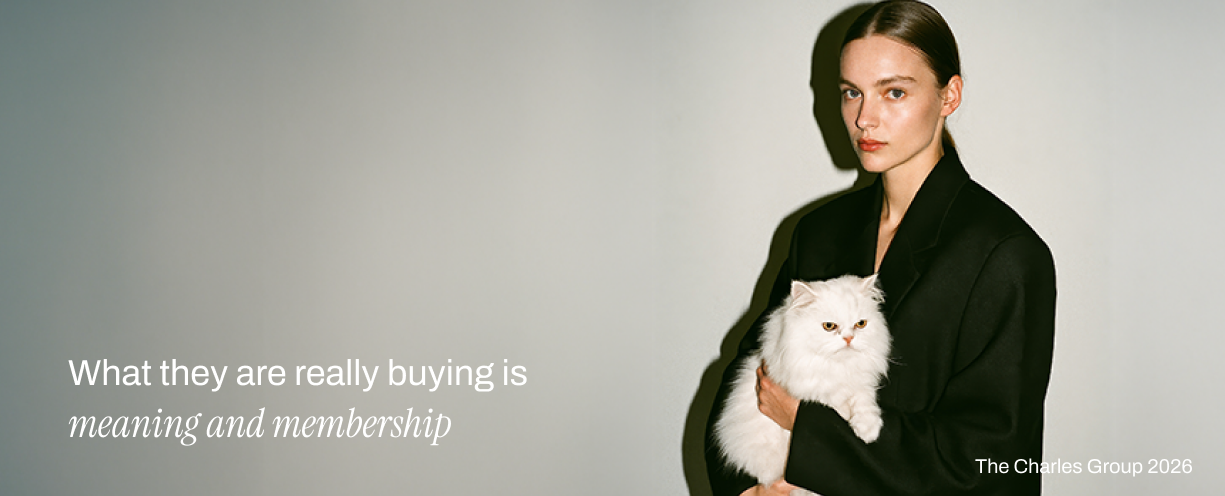
Luxury inverts almost all of that, because the customer does not have a need in the conventional sense. Someone shopping for a fine watch already owns the ability to tell time, so what they are really buying is meaning and membership, along with a signal they want to send to themselves and to the people whose opinion they value. The marketing has to manufacture and protect that meaning, which is a creative act long before it is a performance one.
A few principles sit underneath everything we do in the category.
Aspiration over information. The work is there to make someone want to belong rather than to explain anything, because specs and offers flatten a prestige brand the moment they reframe it as a transaction, and transactions invite comparison. As soon as a luxury buyer starts comparing on price or feature, the brand has already lost the argument it was supposed to win on desire.
Restraint over volume. Mass brands chase frequency and reach because attention is the scarce resource and repetition drives recall, whereas luxury treats its own visibility as a finite asset. Showing up everywhere, all the time, at any cost is how a prestige brand becomes ordinary, and so fewer, better moments are what protect the perception of scarcity that gives the brand its pricing power in the first place.
Price as a signal. In most marketing, price is an obstacle to overcome, but in luxury it is part of the message, a way of communicating exclusivity and the care behind the product. Discounting does more than dent margin, because it tells the market the previous price was a fiction, and that erodes trust with the exact customers a prestige brand most needs to keep.
A longer clock. Performance marketing rewards what happened this quarter, while luxury marketing is mostly an exercise in compounding equity over years. The campaign running today is rarely trying to close a sale this week, since its real job is building the desire that makes a sale possible eighteen months from now, often in someone who is not even in the market yet.
None of this makes luxury marketing soft or unaccountable. The accountability simply lives in different numbers and on a different timeline, which is exactly why so many brands end up measuring the category badly.
The Luxury Brand Marketing Channel Mix
The instinct in most digital marketing is to start with search, on the logic that someone has a need, types it into Google, and wants to find you as the answer. That holds for mass market and falls apart for luxury, because the prestige customer is usually not searching to solve a problem at all. They are being shaped, slowly, into wanting something they did not know they wanted, and that shaping happens in places a search ad cannot reach.
This is the core difference in luxury brand digital marketing, where the job is to build desire and a sense of world rather than to capture demand that already exists, so the mix tilts heavily toward the channels that carry image and atmosphere, the ones that double as proof of standard.
Social, led by Instagram. For most of our luxury clients, Instagram is the primary stage, because it rewards composition and a strong point of view while reaching an audience that treats the feed as a place to discover taste. The work here is editorial in spirit, which means every frame has to look like it belongs to the brand even with the logo removed.
High-production video. Film does the heaviest lifting in the category because it carries motion and sound and casting and mood in a way a still never can, and a single well-made thirty-second film can hold more brand equity than a month of static posts. This is also where production standards matter most, since the gap between prestige and passable is instantly visible on screen.
Owned channels and the brand’s own world. The site, the editorial hub, the email program, and the in-store experience are where a luxury brand controls the full environment, and they are far more than afterthoughts to paid media. They are the destination paid media should be building toward, the place where the brand can tell longer stories at its own pace.
Paid social as reach and desire, not direct response. We still run paid social, though the brief is different, with the objective set on qualified reach and desirability among the right audience rather than a coupon and a hard conversion. Direct-response mechanics that work beautifully for a mass retailer can quietly cheapen a luxury brand, because they train the audience to wait for a deal.
Influence, used with discipline. Creators and partnerships can move a luxury brand, but only the right ones and only on the brand’s terms, since a single misaligned partnership can do more damage than a dozen good ones can repair. We treat creator selection as a casting decision, with the same scrutiny we would give talent in a campaign film.
Search still has a role, mostly in protecting branded terms and capturing the small share of high-intent demand that already exists, but it functions as a floor rather than the strategy itself. For digital marketing for luxury brands, the real growth lever is demand creation, and that lives in image and film long before it ever lives in a keyword.
Content Production Standards for Prestige Brands
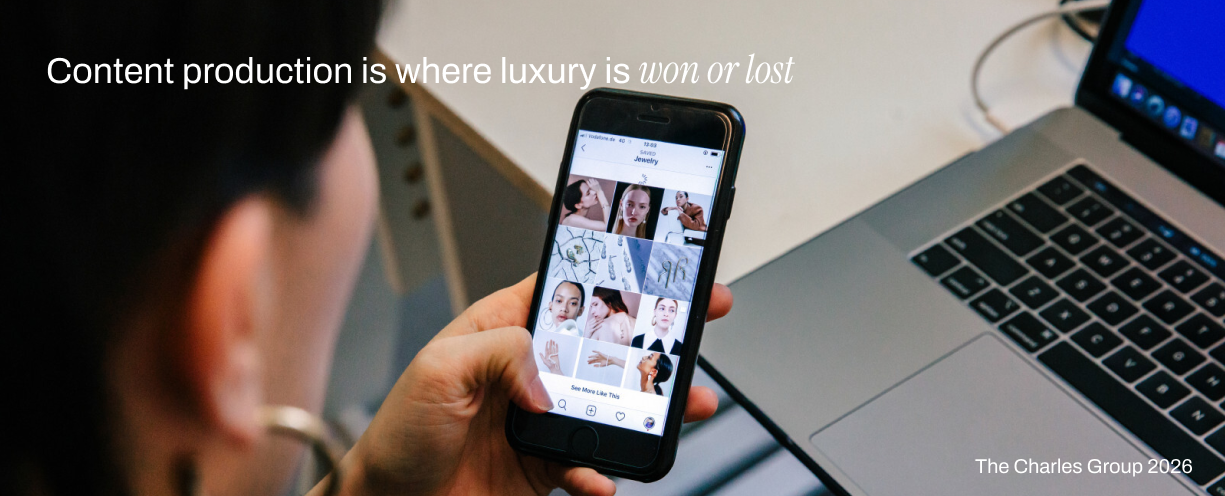
This is the part of the work we care most about, because it is where luxury is won or lost in practice. Strategy sets the direction, but production is where the brand either earns belief or quietly forfeits it.
Prestige production value in 2026 has little to do with spending the most money and everything to do with control, over light and casting and location, and over the hundred small decisions in post that most people will never consciously notice and every person will feel. A luxury audience is fluent in quality even when it cannot articulate why something reads as expensive, registering the difference in a fraction of a second and holding the brand to that standard everywhere it appears.
The hardest discipline is consistency, because a luxury brand has to look like itself across a campaign film, a paid social cut, a site banner, and a single product still shot for a retailer. When the world holds together across every asset the brand feels intentional and permanent, and when it fractures even slightly the whole thing starts to feel borrowed. Most brands lose the plot not in the hero film, which gets the budget and the attention, but in the long tail of assets that get made quickly and reviewed loosely.
There is a real asymmetry at work, because for a mass brand a mediocre asset is a missed opportunity, while for a luxury brand the same asset is active damage that gives the audience permission to doubt the prestige they are being asked to pay. Cheap content does more than underperform, since it revises the brand downward in the mind of the exact person you are trying to convince.
A word on AI, since it is the question every client asks me now. Generative tools have a real place in prestige production, mostly in the early and unglamorous stages, where they help a team move fast through concept exploration and previsualize a set before anyone commits real budget, and where they take on the versioning that the scale of modern channels demands. Where they still fall short is the hero moment, the texture of real light on a real material and the kind of human imperfection that makes a cast face feel true rather than rendered. Luxury lives in exactly those details, so we use AI to protect the budget for the moments that have to be real instead of replacing them.
Production at this level is a form of brand protection, because every frame is either reinforcing the brand’s claim to standard or undermining it, and there is no such thing as a neutral asset. That is the lens we bring to every shoot, and it is the standard a prestige brand should hold any partner to.
Luxury Campaigns in Practice
The principles above are easier to trust once you can see them applied, so the campaigns below come straight from our luxury client work.
The Seagate Delray
The Seagate is a Delray Beach institution with deep local roots, and when Turnberry completed a $53M renovation, the property came to us to claim a place at the top of South Florida hospitality. We built the digital side from the ground up, taking on the website, a social program made for the platforms rather than adapted to them, and a paid media strategy launched from scratch. The creative direction moved away from posed resort photography toward content that captured the feeling of belonging somewhere, the beach club at golden hour, a quiet spa ritual, coastal light held in close, intimate framing. South Florida has no shortage of luxury hotels, but it has a shortage of places that feel like somewhere, and that was the gap the work set out to own.
On paid media, a data-led program across Google and Meta, including a Meta conversion pixel we built from scratch, turned the property into an omnichannel performer. Year over year, revenue rose 124% from $132K to $296K while the average cost per click fell 94% to $0.11, and the hotel booking campaign returned 7.69x its spend in October. On the organic side, Instagram followers grew 483% month over month between August and December as content output climbed 88% and engagement held at a 2.06% reach rate across platforms.
Cincoro
Cincoro arrived in a crowded tequila category with a set of A-list founders and an unusual ambition, which was to build a brand whose liquid mattered more than its celebrity. We read the cultural and competitive picture, found the white space, and built a platform anchored in authenticity and a sense of intimate connection rather than spectacle. The strategy, Life Better Lived: Sip, Savor, Share, grew out of a post-pandemic insight that the occasions worth drinking for had narrowed to the people closest to you, and we gave that idea a world called Of the Earth, one that stripped away excess to get at what the brand actually was. From there it ran across the website, email, organic and paid social, and influencer work, with each channel calibrated to hold the prestige positioning while still moving engagement and conversion. The job was to take Cincoro from famous founders to a famous brand.
Mackage
Mackage came to us through its parent, APP Group, which wanted a performance media partner to rebuild and sharpen campaigns across two very different brands, Mackage and Soia & Kyo. The work ran across paid social, the full Google stack of search, Shopping and Performance Max, and Bing search, and the mandate was efficiency without letting the brand slip. We ran it on a simple discipline, segment, then test, then refine, working the controls each platform actually exposes, from creative and audiences through search terms and the on-site experience, so the algorithm had better inputs to optimize against. At no point did the work ask the brand to look cheaper in order to perform better.
The numbers moved together, which is the part that matters. Return on ad spend reached 8.26x across paid social, Bing and Google, up from 5.51x, and ROAS performance rose 49% year over year. Inside Performance Max, media cost per purchase fell 28%, while average order value on paid media direct sales climbed 24%, so the spend got more efficient and the basket got bigger at the same time.
For the full set of luxury case studies, see our luxury work at www.thecharlesgrp.com/work/luxury-brand-marketing/
Measuring Luxury Brand Health
The fastest way to mismanage a luxury brand is to judge it by mass-market numbers, since clicks and cost per acquisition and last-click attribution were all built for a world where a need leads to a search and then to a purchase inside a short, traceable window. Luxury rarely behaves that way, because the path to a purchase runs long and crosses channels and often finishes offline, which means last-click attribution will systematically underrate the work that actually built the desire.
So we measure brand health, and we read sales as a lagging confirmation of it rather than the primary signal.
The leading indicators we watch most closely are brand awareness and consideration among the right audience rather than the broadest one, because a prestige brand does not need to be known by everyone so much as desired by the people who can afford it and the people who aspire to. Tracking that desire over time, through brand lift studies and consideration surveys, tells you whether the marketing is moving the only opinions that matter.
Alongside that, we track sentiment and the quality of conversation around the brand, since volume of mentions is a vanity number while the texture of those mentions, whether the brand is being discussed in the terms it wants to own, is the real read. Share of voice within the category matters too, particularly against the specific competitors the brand measures itself against rather than the whole market.
Branded search demand is one of the most honest signals we have, because when desire-building creative is working, more people start looking for the brand by name. That rising branded search is often the earliest hard evidence that the soft work is landing, and it shows up well before anything reaches the sales line.
The discipline here is patience, because brand health metrics move slowly and a little unevenly, and the temptation to abandon a sound strategy because last week’s numbers were flat has killed more good luxury work than bad creative ever has. The right approach is to set the leading indicators and the timeline upfront, then hold the line when the pressure comes.
One Park Tower by Turnberry
Turnberry has spent more than fifty years building destinations across hospitality, residential and retail, yet its digital presence had never matched the portfolio behind it. We came on as agency of record to fix that, building the digital foundation from the ground up and shaping a single brand narrative, then putting the strategic and creative infrastructure in place to carry long-term growth across the corporate brand and its individual developments, One Park Tower and Solé Mia among them.
For One Park Tower, the approach paired a data-led creative process with fluid omni-channel media across paid social, search, display and publisher partners. The campaign, It’s So Real It’s Surreal, turned a construction milestone into a cultural moment by inverting the Fake Out of Home trend, building real large-format installations that looked too extraordinary to be real. The work read as spectacle and performed as a sales engine.
It drove more than $20M in directly attributable sales to paid media and lifted average monthly walk-in volume by 85%. Monthly lead volume on form fills grew 433%, while cost per lead fell 84% across every paid channel.
The Luxury Brand Marketing Stack
A prestige program needs the right capability behind it, and the stack for luxury looks different from a standard digital marketing setup because so much of the value sits in production and brand thinking rather than in tooling alone.
Strategy and creative direction. Everything starts here, with a strategy that defines the world the brand wants to own and a creative direction that holds that world consistent across every asset and channel, because without a strong center the rest of the stack just produces volume.
Production capability. This is the part most brands underestimate, since prestige content requires real production resources, from photography and film through design and motion and post. At The Charles Group we run this across North America, EMEA, and APAC, combining full-time teams with a wider network so a brand can produce at a high standard in the markets it actually operates in.
Media planning and buying for the right audience. The media layer in luxury runs on precision and context rather than scale for its own sake, with the objective set on reaching a qualified audience in prestige environments, which calls for planning that values where an impression appears as much as how many there are.
Measurement and brand tracking. A proper stack includes the means to track brand health over time rather than campaign performance alone, with brand lift studies, sentiment and share-of-voice monitoring, and branded search tracking in place from the start, because you cannot prove the value of equity work without a baseline.
An operating model that fits. The thing that ties it together is how the partner works alongside the brand’s own team. Our Flex Model is built to operate as an extension of an in-house team rather than a vendor at arm’s length, which matters in luxury because the brand voice is too precise to hand off and forget.
When a brand is evaluating a luxury brand marketing agency, the checklist worth running comes down to strong strategy, genuine production capability, media discipline, and honest measurement, and a partner missing any one of those will struggle to build and protect a prestige brand over time.
Common Questions About Luxury Brand Marketing
What is luxury brand marketing?
Luxury brand marketing builds desire and long-term equity for prestige brands. The goal is belonging and status rather than the direct, need-based response that drives most mass-market campaigns, which is why the product works as proof more than pitch.
How is luxury brand digital marketing different from mass-market digital marketing?
Luxury brand digital marketing prioritizes reach and world-building and desire over direct response. Search ads and discount mechanics that suit mass brands can quietly cheapen a prestige one, so the mix leans toward social, film, and owned channels instead.
What does a luxury brand marketing agency do?
A luxury brand marketing agency sets strategy and makes prestige content, then plans media for the right audience and measures brand health rather than clicks alone. The production standard is usually the deciding factor.
How do you measure luxury brand marketing?
You measure luxury brand marketing through brand health indicators like awareness and consideration among the right audience, plus sentiment and branded search demand. Last-click attribution tends to misread it because the buying cycle is long and crosses channels.
Do luxury brands need digital marketing?
Yes, and the need keeps growing. Digital marketing for luxury brands is now central, from social and editorial film through to owned channels and brand tracking, and the real discipline is matching prestige standards to formats that were built for volume.
Building a Luxury Brand Worth Believing In
The brands that endure in this category share one trait, in that they treat every decision, from the casting of a film to the timing of a post, as a statement about who they are. That standard is demanding, and it is also the entire point, because prestige is a promise and the marketing either keeps it or breaks it.
If you are building a luxury brand and want a partner who understands the difference, see how we work across the category on our luxury practice page: www.thecharlesgrp.com/industry/luxury/