What Is Programmatic Advertising? Everything Brand Marketers Need to Know
By Aaron Edwards, CEO, The Charles Group
There’s a version of every conversation about programmatic that starts with a vendor’s pitch and ends with the marketer more confused than when they started. The category attracts jargon. The platforms compete to invent new acronyms. The trade press covers it like it’s quantum physics.
It isn’t. Programmatic is the way most digital media gets bought in 2026. If you’re a CMO signing off on a media plan, you need to understand it well enough to make decisions. You don’t need to understand it well enough to traffic the campaign.
This guide is for the first group. It’s written by people who buy programmatic media every day for Fortune 50 brands, luxury houses, hospitality groups, and category-defining DTC players. Not by a SaaS company trying to sell you their tool.
What follows: what programmatic actually is, how the plumbing works without getting lost in it, the channels that matter for a brand marketer, what we see working in 2026 from active campaigns, the mistakes we see brand marketers make most often, and an honest answer on when to run programmatic in-house versus through an agency.
Programmatic in 60 Seconds
Programmatic advertising is the automated buying and selling of digital ad inventory using software, with most decisions made in milliseconds via real-time bidding.
That’s it. That’s the definition.
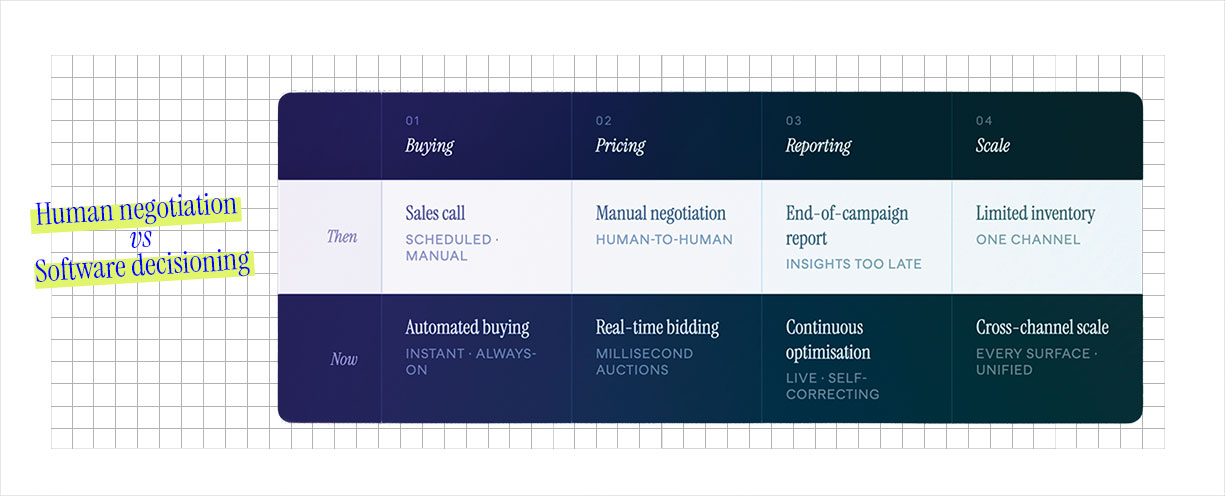
The old way of buying digital media was a sales call. A media buyer would phone a publisher’s ad rep, negotiate a rate, hand over a creative, and wait for the report to come back at the end of the campaign. It worked. It was also slow, opaque, and impossible to scale.
The programmatic way is software. A buyer loads creative, audience targeting, and budget parameters into a piece of software called a demand-side platform (DSP). When a person loads a webpage, opens an app, or starts streaming a TV show, the publisher’s software (a supply-side platform, or SSP) puts that impression up for sale on an ad exchange. The DSP decides in roughly 100 milliseconds whether to bid on that impression and how much. The highest bid wins. The ad serves. The cycle repeats billions of times a day.
Everything else about programmatic is detail on top of that loop.
Why brand marketers should care: Programmatic is how you reach a specific audience at scale across a lot of disconnected places at once. The same engine that places a display ad on a niche publication also places your CTV ad in a streaming show and your audio ad in a podcast. One buying motion, dozens of channels, all measurable against the same KPIs.
How It Actually Works
Three pieces matter. Skip the rest until you need it.
The DSP (Demand-Side Platform). This is what the buyer (you, your agency, your in-house team) uses to plan, target, bid, and report. Think of it as the cockpit. The DSPs that actually matter for brand marketers are a small list, and we’ll cover specifics later.
The SSP (Supply-Side Platform). This is what the publisher (The New York Times, Hulu, a podcast network, a retail site) uses to make their inventory available. The buyer never logs into the SSP. It’s worth knowing exists because the same impression often flows through multiple SSPs, which affects pricing and quality.
The Ad Exchange. The marketplace where DSPs and SSPs meet. The part most people picture when they think of programmatic: an auction happening in real time, billions of times a day, deciding which ad serves on which page in front of which person.
There’s a fourth concept worth knowing. The deal type.
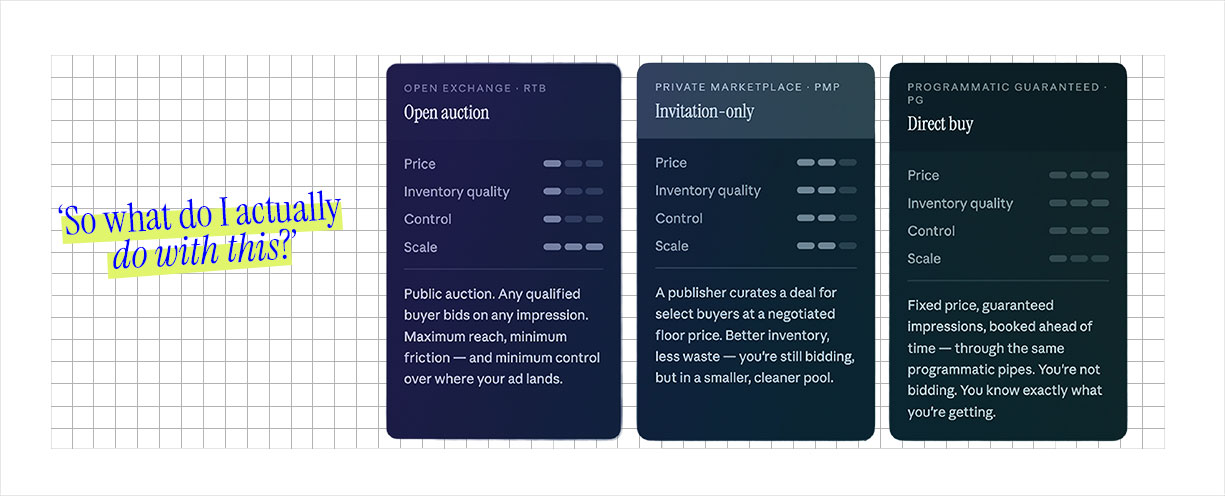
- Open exchange (RTB). The public auction. Any qualified buyer can bid on any qualified impression. Cheapest, fastest, lowest control.
- Private marketplace (PMP). An invitation-only auction. A publisher curates a deal for a specific buyer or set of buyers at a negotiated floor price. Better inventory quality, less leakage.
- Programmatic guaranteed (PG). A direct buy at a fixed price, executed through the programmatic pipes. You’re not bidding. You’re booking inventory ahead of time. Highest control, highest price.
A good media plan uses all three. The wrong question is “do we run programmatic?” The right question is “what’s our mix across open exchange, PMP, and PG, and why?”
Two other terms you’ll hear and shouldn’t be afraid of. Header bidding is a technical implementation that lets publishers solicit bids from multiple SSPs at once. It changed pricing dynamics. Your team should know about it. You don’t need to.
Identity is the umbrella term for how buyers and sellers recognize a user across sites. Cookies were one version of this. With third-party cookies in deprecation across Chrome and Safari already long gone, the industry is sorting through a set of replacements: Google’s Privacy Sandbox, Unified ID 2.0, RampID, and a growing number of first-party data approaches that lean on logged-in audiences. None of them have won outright yet. For a brand marketer, the practical implication is simple. The brands that invested in their own first-party data have more options. The brands that didn’t are watching their targeting and measurement degrade in real time. If you don’t have a first-party data strategy, that’s the work to start on this quarter.
Real-time bidding, in one example.
Picture a person opening the New York Times homepage on their phone at 8:43 a.m. The page loads. One of the ad slots on that page is up for auction. Within the time it takes the homepage to finish rendering, the SSP sends a bid request out to every connected DSP with details about the page, the user (anonymized to whatever extent the identity setup allows), the device, and the slot. Every DSP that thinks this impression matches an active campaign decides what to bid. The highest bid wins. The winning DSP’s ad serves. The whole sequence takes about 100 milliseconds. That’s programmatic. The mechanics are the same whether the slot is a banner on a website, a 15-second pre-roll on Hulu, or an audio ad in a Spotify break. The auction is the constant. The channel is the variable.
The Programmatic Channels Marketers Should Know
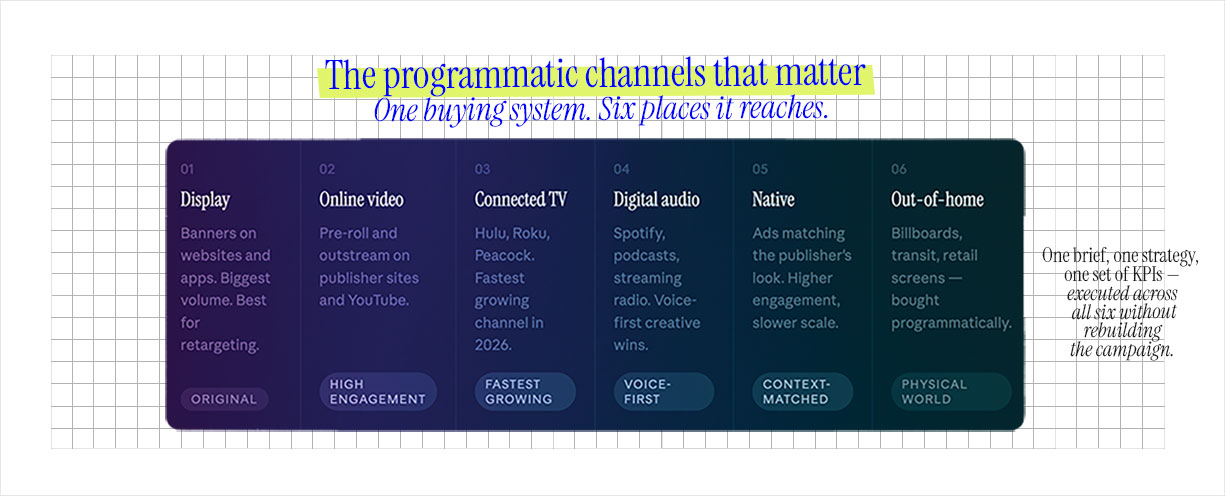
“Programmatic” used to mean display ads on the open web. It doesn’t anymore. The plumbing now extends to most paid digital media.
Display. Banner and rich media ads on websites and apps. The original programmatic channel, still the largest by volume. Lowest creative impact per impression, but unbeatable for retargeting and lower-funnel reach.
Online video. Pre-roll, mid-roll, and outstream video on publisher sites and YouTube. High engagement, easy to measure, and a natural place to repurpose film assets from a brand campaign.
Connected TV (CTV). Programmatic video on streaming services. Hulu, Peacock, Tubi, YouTube TV, Roku, Samsung TV Plus, and the rest. The fastest-growing programmatic channel in 2026 and the one most brand marketers underestimate. More on this in the next section.
Digital audio. Spotify, podcast networks, streaming radio. A small but real channel for the right brand. Voice-driven creative outperforms repurposed TV audio.
Native. Sponsored content units that match the look and feel of the publisher’s site. Higher engagement than display, slower to scale, more dependent on creative quality.
Digital out-of-home (DOOH). Billboards, transit screens, retail screens, gas station displays. Yes, you can buy a Times Square board programmatically now. The data targeting is rough compared to digital, but the impact is real.
Every channel above runs through the same DSPs and follows the same buying logic. That’s the practical advantage of programmatic. One brief, one media strategy, one set of KPIs, and you can execute across half a dozen channels without rebuilding the campaign for each one.
What The Charles Group Sees Working in 2026
Here is what our media team is actually seeing in active campaigns. Three observations.
1. CTV is the new prime time.
The CTV shift isn’t a forecast anymore. It’s the reality. Audiences moved from linear TV to streaming faster than the industry’s measurement caught up, and the brand marketers winning right now are the ones who treated CTV as primary reach, not as a digital add-on.
For TCG clients, CTV now anchors most upper-funnel media plans. We buy across the major ad-supported platforms (Hulu, Peacock, YouTube, Tubi, Pluto, and the FAST channels) through a mix of DV360 and direct platform integrations. The buys are measurable. We can tie a CTV impression to a brand search lift, an incremental site visit, or a downstream conversion, and we do.
Pricing has compressed. CPMs that were $50 and up in 2022 are settling into the $20 to $35 range for premium inventory and the $10 to $15 range for FAST and long-tail. Audience targeting got better. Reach is huge. If your brand isn’t running CTV in 2026, you’re paying linear TV prices for fewer eyeballs.
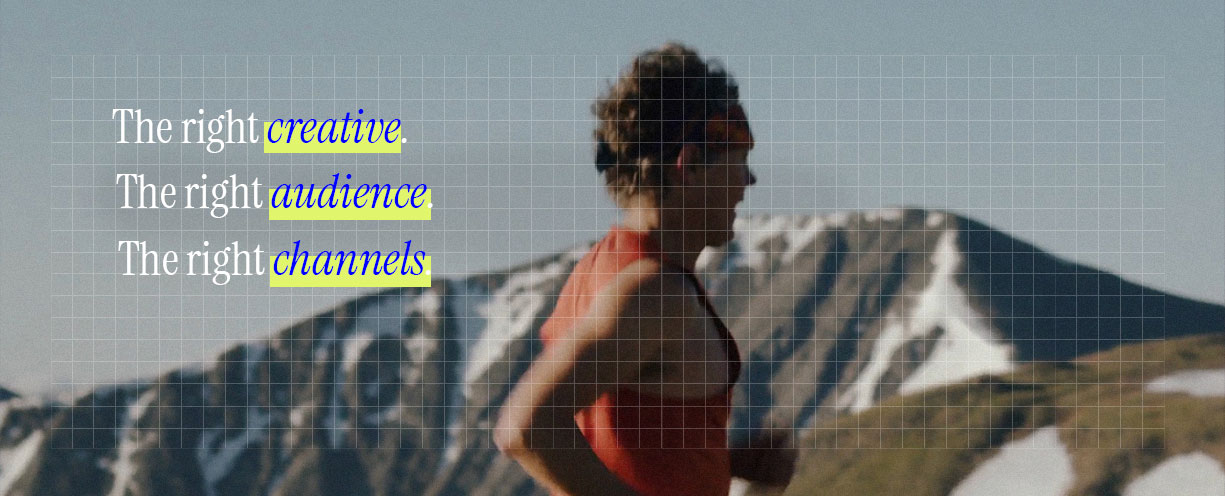
A recent example from our work. When we launched BIRKENSTOCK’s recovery-for-runners campaign, the brand films ran programmatically across YouTube and connected TV against a tightly defined runner audience. We hit an 86% video completion rate against a category benchmark of roughly 30% and CPMs that came in 75% below the Meta fashion benchmark. The campaign delivered over 60 million impressions in the first 60 days, the highest-reaching digital-first launch in BIRKENSTOCK’s history. That’s not because the targeting was magic. It’s because the creative was made for the audience, served on the channels the audience watches, bought through the platforms with the best inventory access. Programmatic done right looks like that.
2. Retail media networks have changed the data picture.
Amazon DSP started this. The broader retail media ecosystem (Walmart Connect, Target’s Roundel, Kroger Precision Marketing, Best Buy Ads) has changed how we think about audience data. The retailers know what people buy. That’s a closed-loop signal no third-party data company can match.
For our commerce-driven clients, retail media now runs in two layers. Endemic placements on the retailer’s own properties (Amazon’s homepage, sponsored search on Walmart.com), and off-property activation using the retailer’s audience data to target ads across the open web through their DSP. Amazon DSP is the most mature version of this. The others are catching up fast.
The catch: every retailer wants you in their walled garden, and the data doesn’t always travel. The strategic question for a brand marketer is which retail media networks are big enough to justify a dedicated practice and which are good enough to plug into your existing programmatic mix.
3. Curated and PMP deals beat the open exchange.
Five years ago, most programmatic spend ran through the open exchange. The pitch was scale and efficiency. The reality, for a lot of brands, was made-for-advertising sites, low-quality inventory, and ad fraud that no amount of brand safety filtering fully solved.
In 2026, our default for any brand-sensitive campaign is curated deal packages and PMPs, not open exchange. We run inventory curators that pre-filter publishers for quality. We negotiate PMPs directly with premium publishers for our luxury and enterprise clients. We use the open exchange for reach extension and retargeting, not for primary brand spend.
The trade-off is real. PMP and curated inventory costs more on a CPM basis. The savings come from not paying for impressions that never got a human in front of them. Once we factor in viewability, completion rate, and brand suitability, premium inventory wins on cost per real impression nearly every time.
Which DSPs Actually Matter
There are dozens of demand-side platforms. There’s a much shorter list that actually matters for a brand marketer. Here’s how we think about it.
DV360 (Google). Our default for any plan that needs YouTube, Google’s audience signals, or programmatic CTV at scale. The integration with Google’s data ecosystem is unmatched, and YouTube alone is reason enough to have it in the stack. Where it’s weaker: native, some long-tail inventory access, and the user experience can feel enterprise-heavy.
Amazon DSP. The only way to access Amazon’s shopper data and Amazon-owned inventory like Prime Video and Twitch. If you’re a CPG, retail, or commerce-driven brand, Amazon DSP isn’t optional anymore. It’s where the closed-loop attribution lives. Where it’s weaker: open web inventory and audience flexibility outside Amazon’s ecosystem.
StackAdapt, Yahoo, and the independent layer. Where we go for native at scale, mid-market segments, and ease of use. StackAdapt in particular has earned a slot in our stack because it covers native, display, video, CTV, and audio in one platform with a UI that doesn’t require a six-month onboarding. Yahoo DSP holds specific value for inventory and identity in pockets where it still dominates.
The big independent DSP a lot of agencies default to is The Trade Desk. It’s a credible platform with real strengths in CTV inventory access. We’ve used it. For our current client mix, DV360 plus Amazon DSP plus the independent layer covers the inventory, data access, and channel breadth we need, with fewer platform fees and a tighter integration with the rest of our stack. The right DSP set isn’t a universal answer. It’s a function of where your inventory is, where your data is, and where your money goes.
Common Mistakes Brand Marketers Make
We see the same mistakes across a lot of programmatic plans. Five worth flagging.
1. Treating programmatic as a single channel. Programmatic is the plumbing. It isn’t the channel. A programmatic plan that lumps CTV, display, audio, and DOOH into one bucket and reports them together is a plan that can’t be optimized. Break the channels out. Measure them separately. Manage them as a portfolio.
2. Picking the wrong DSP for the job. No DSP does everything well. The right DSP depends on where your inventory is and where your data is. If your business runs on Amazon, Amazon DSP is mandatory. If your audience lives on YouTube and your reporting lives in GA4, DV360 will earn its keep. If you need native at scale or you’re running mid-market budgets, an independent like StackAdapt is usually the better answer than overpaying for an enterprise seat.
3. Underinvesting in creative. The single biggest predictor of programmatic performance is the creative, and it gets the smallest budget. We’ve watched brands spend seven figures on a programmatic flight and pull creative from a deck. The DSP can’t fix a weak ad. The DSP can only serve a weak ad more efficiently.
4. Optimizing for CPM instead of cost per real impression. A $2 CPM looks great until you find out 70% of the impressions were below the fold, ran on a clickbait site, or never loaded. The right metric is cost per viewable impression on brand-suitable inventory. Optimize for that. Track it. Hold the buy accountable to it.
5. Reporting the wrong scoreboard. Programmatic gets blamed for not driving last-click conversions when nobody set it up to. CTV doesn’t drive last-click conversions. Brand video doesn’t drive last-click conversions. They drive incremental lift, audience growth, and downstream search and direct response. Measure programmatic against the job you hired it for, not the job a different channel does.
6. Ignoring supply path optimization. An impression often passes through three or four intermediaries between the buyer and the publisher, and each one takes a fee. The same publisher impression can show up across multiple SSPs at different prices with different quality flags. Supply path optimization is the discipline of routing buys through the cleanest, shortest paths to inventory. It’s not glamorous. It’s also the single biggest move a media team can make to reclaim 10 to 20 percent of working media budget without changing creative, targeting, or spend levels.
In-House vs Agency: An Honest Answer
We’re an agency. You should expect us to argue for using an agency. Here’s the honest version.
Run programmatic in-house when:
- You have one or two primary DSPs and your campaigns are highly repeatable (always-on retargeting and prospecting, for example).
- You have an internal team with at least one senior media buyer who’s worked in a DSP for more than three years.
- Your annual programmatic budget is high enough to justify a fully-loaded $200K+ headcount cost per buyer plus DSP seat fees.
- Your data is in good shape and you’ve already built audience segments, conversion tracking, and a reporting stack.
Use an agency when:
- You’re running across more than two DSPs and your team would have to split attention.
- You need access to negotiated rates and PMP deals that depend on aggregate buying power.
- You have campaigns that need creative, strategy, and media in lockstep, not handed off across teams.
- Your in-house team is good but small, and asking them to also stay current on identity, retail media, CTV measurement, and supply path optimization is unrealistic.
- You want one team accountable for the integrated brand and performance picture, not three teams pointing at each other.
There’s a hybrid that often works better than either pure model. The brand keeps a senior buyer in-house who owns strategy, vendor relationships, and the always-on programs. The agency runs the heavy lift on campaign flights, supply optimization, and the brand-and-performance integration. The in-house buyer is the agency’s main partner, not their replacement.
Programmatic FAQ
Is programmatic advertising the same as display advertising?
No. Display is a channel. Programmatic is the way most display gets bought, but programmatic now also covers video, CTV, audio, native, and DOOH. A campaign can be display without being programmatic (a direct buy with a publisher), and it can be programmatic without being display (a CTV buy through DV360, for example).
How is programmatic different from paid social like Meta and TikTok?
Paid social platforms operate self-contained auction systems inside their own walled gardens. Programmatic refers to the broader open ecosystem of DSPs, SSPs, and exchanges that buy across the open web, CTV, audio, and many other channels. Most brand marketers run both, and the same media strategy should govern the mix.
What does a programmatic campaign cost?
It depends on channel, audience, and inventory quality. Open-exchange display can run a few dollars per thousand impressions. Premium CTV inventory sits in the $20 to $35 CPM range for ad-supported streaming. PMP and programmatic guaranteed deals price higher in exchange for inventory quality. The wrong question is what programmatic costs. The right question is what cost per outcome you’re willing to accept against the goal of the campaign.
Do I need to be a big advertiser to run programmatic?
No. There’s a healthy middle market of independent DSPs (StackAdapt is a good example) that support smaller budgets without requiring enterprise commitments. The economic minimum has dropped a lot in the last five years. The question isn’t whether you can run programmatic. It’s whether you have the strategy and creative to make it worth running.
How do I measure whether a programmatic campaign worked?
Set the brand and performance KPIs at kickoff against the same audience: viewable impressions and video completion rate on the brand side, cost per qualified conversion or incremental revenue on the performance side, brand search lift and audience growth in the middle. Read all three together. A programmatic campaign that moved your brand search volume and your direct-to-site traffic is working, even if the last-click attribution column looks thin.
The Bottom Line
Programmatic is plumbing. The plumbing matters because most of your digital media is going to run through it. The plumbing is also not the story. The story is whether your media plan is built on the right audience insight, executed against the right channels, with creative that’s worth serving and measurement that tells the truth.
If you understand the plumbing well enough to ask the right questions, you’ve cleared the bar that most CMOs haven’t. You can stop reading explainers like this one and go work on the parts that actually move the business.
If you’d like a second set of eyes on how your programmatic mix is working, or you’re thinking about a shift toward more CTV, more retail media, or more curated inventory, we’d be happy to take a look.
Learn more about our Media practice, read the BIRKENSTOCK case study, or get in touch about a programmatic audit for your brand.